Here are some of the photographs which i took during my trip to Marcel. Its a place in the outskirts of Goa. Lovely place for photography. Photographs here are all taken on the 1st and 2nd of January 2014. Hopefully you all will like these photographs..
 |
| Sunrise in the foggy fields of Marcel. A place in Goa.... |
 |
| A photograph captured on 1st January 2014 during a morning walk in Marcel, Goa. |
 |
| A photograph captured on 1st January 2014 during a foggy morning walk in Marcel, Goa. |
 |
| The Purple Sunbird (Cinnyris asiaticus) is a small sunbird. Like other sunbirds they feed mainly on nectar, although they will also take insects, especially when feeding young. They have a fast and direct flight and can take nectar by hovering like a hummingbird but often perch at the base of flowers. The males appear all black except in some lighting when the purple iridescence becomes visible. Females are olive above and yellowish below. Captured at Marcel, Goa (Hand Held). |
 |
| The Purple Sunbird Male. |
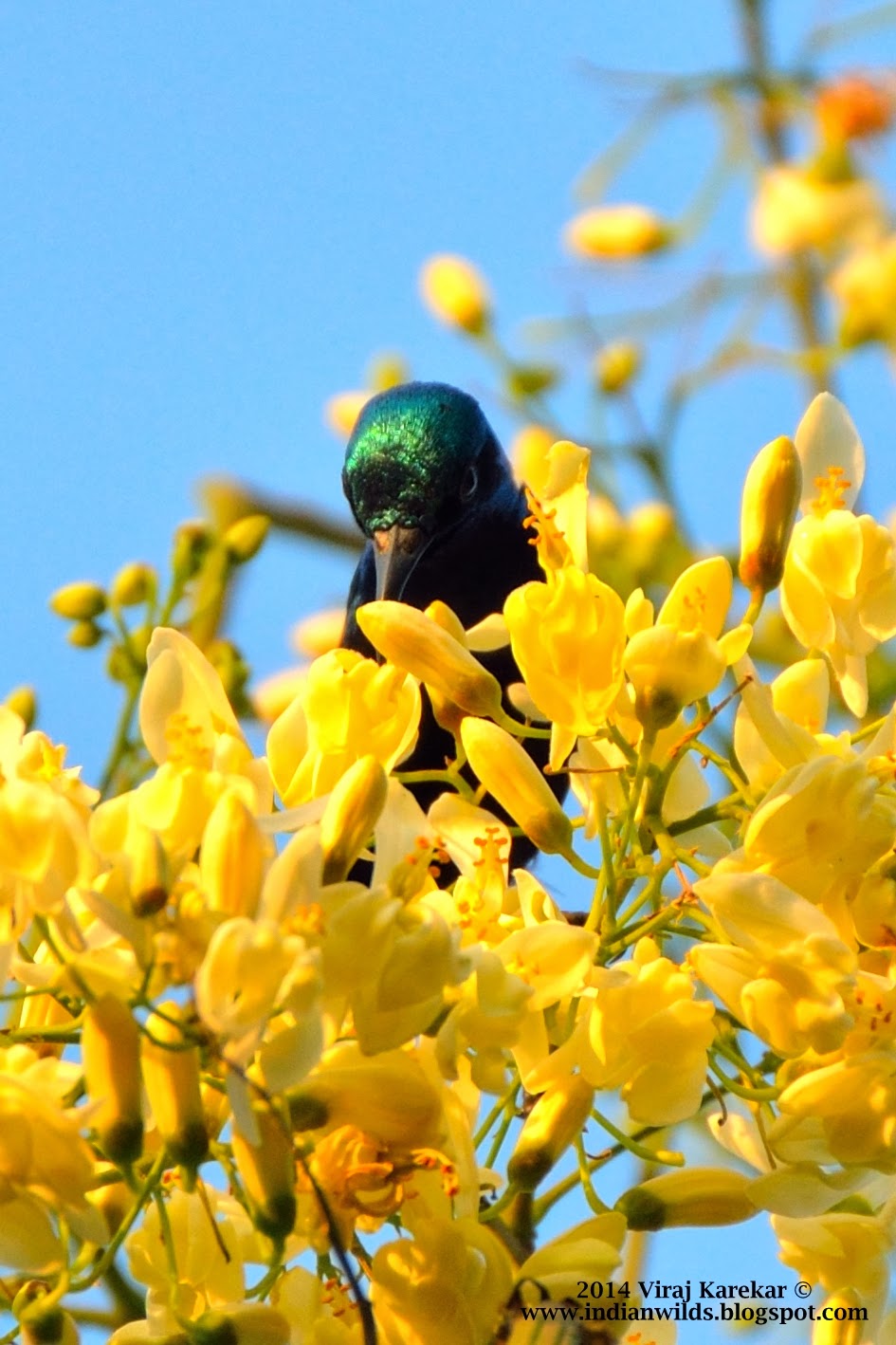 |
| The Purple Sunbird, Male feeding on nectar. |
 |
| The Purple-rumped Sunbird (Leptocoma zeylonica) is a sunbird endemic to the Indian Subcontinent. Like other sunbirds, they are small in size, feeding mainly on nectar but sometimes take insects, particularly when feeding young. They can hover for short durations but usually perch to feed. They build a hanging pouch nest made up of cobwebs, lichens and plant material. Males are brightly coloured but females are olive above and yellow to buff below. |
 |
| A Purple-rumped Sunbird in flight. It was very difficult to capture this on in flight. My camera lens doesn’t support that well for such tiny birds which move so quick… But still some how managed to capture this for the first time in flight… Captured in Marcel, Goa.. |
 |
| The Asian Paradise Flycatcher (Terpsiphone paradisi) is a medium-sized passerine bird native to Asia. Males have elongated central tail feathers, and in some populations a black and rufous plumage while others have white plumage. Females are short-tailed with rufous wings and a black head. They feed on insects, which they capture in the air often below a densely canopied tree. |
 |
| Adult Asian Paradise Flycatchers are 19–22 cm (7.5–8.7 in) long. Their heads are glossy black with a black crown and crest, their black bill round and sturdy, their eyes black. Female are rufous on the back with a greyish throat and underparts. Their wings are 86–92 mm (3.4–3.6 in) long. Young males look very much like females but have a black throat and blue-ringed eyes. As adults they develop up to 24 cm (9.4 in) long tail feathers with two central tail feathers growing up to 30 cm (12 in) long drooping streamers. |
 |
| Adult Asian Paradise Flycatchers are 19–22 cm (7.5–8.7 in) long. Their heads are glossy black with a black crown and crest, their black bill round and sturdy, their eyes black. Female are rufous on the back with a greyish throat and underparts. Their wings are 86–92 mm (3.4–3.6 in) long. Young males look very much like females but have a black throat and blue-ringed eyes. As adults they develop up to 24 cm (9.4 in) long tail feathers with two central tail feathers growing up to 30 cm (12 in) long drooping streamers. Young males are rufous and have short tails. They acquire long tails in their second or third year. Adult males are either predominantly bright rufous above or predominantly white. Some specimens show some degree of intermediacy between rufous and white. Long-tailed rufous birds are generally devoid of shaft streaks on the wing and tail feathers, while in white birds the shaft streaks, and sometimes the edges of the wing and tail feathers are black. |
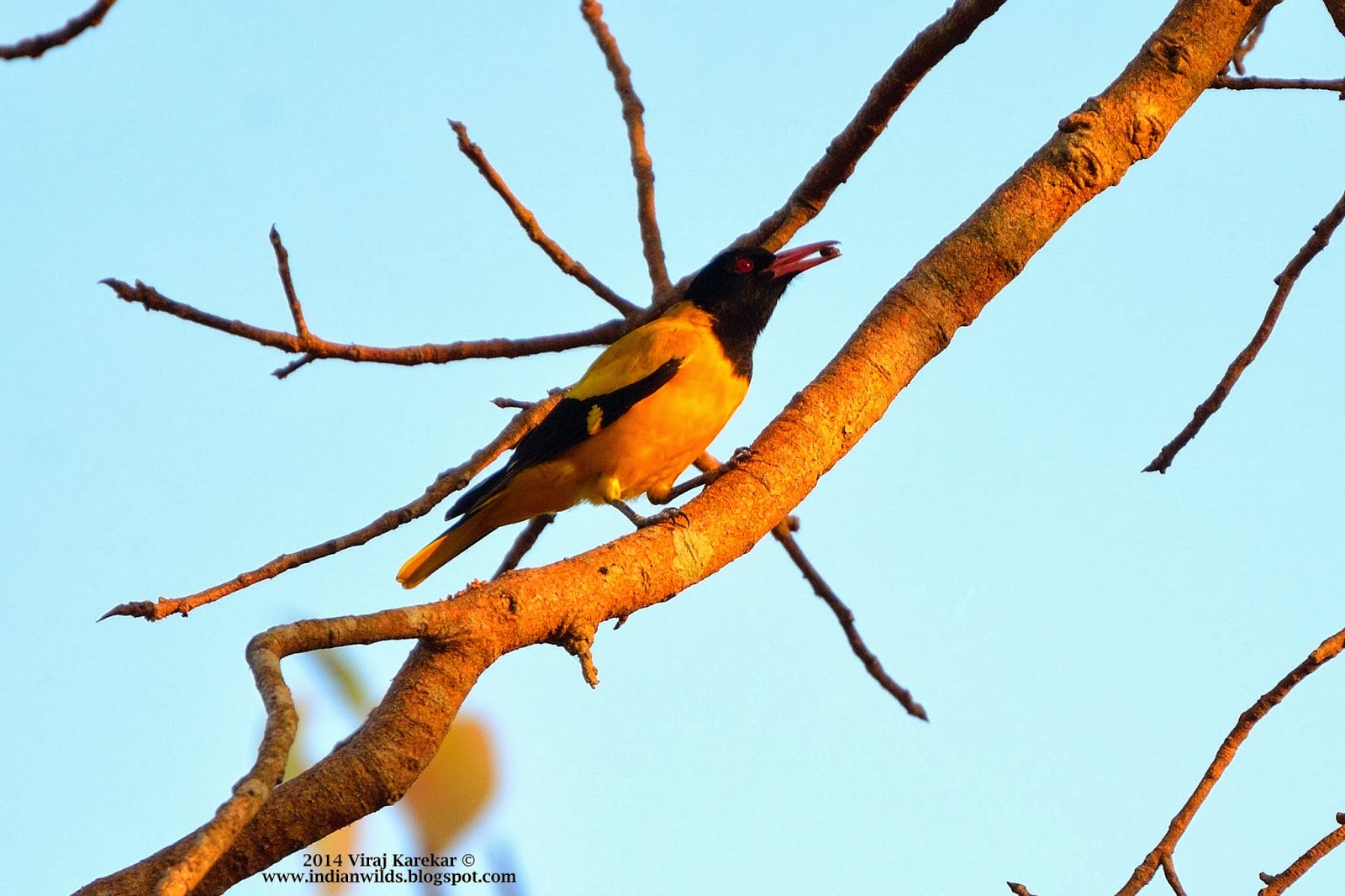 |
| The Indian Golden Oriole, (Oriolus kundoo) is a species of oriole found in the Indian Subcontinent and Central Asia. The species was once considered to be a subspecies of the Eurasian Golden Oriole, but has been elevated to a full species on the basis of differences in morphology, plumage, calls and the fact that the two do not intergrade. Adult males can be told apart from the Eurasian Golden Oriole by the black of the eye stripe extending behind the eye. The Indian Golden Oriole is a partial migrant. It breeds in Pakistan, Uzbekistan, Turkmenistan, Kazakhstan, Kyrgyzstan, Tajikistan, Afghanistan and Nepal, as well as much of India. The Indian populations are largely resident while other populations are migratory. |
 |
| Very similar to the Eurasian Golden Oriole but has more yellow in the tail and has a paler shade of red in the iris and bill. The male has the black eye stripe extending behind the eye, a large carpal patch on the wing and wide yellow tips to the secondaries and tertiaries. The streaks on the underside of females is more sharp than in the females of the Eurasian Golden Oriole. |
 |
| The Asian Koel (Eudynamys scolopaceus) is a member of the cuckoo order of birds, the Cuculiformes. It is found in South Asia, China, and Southeast Asia. It forms a superspecies with the closely related Black-billed and Pacific Koels which are sometimes treated as subspecies. The Asian Koel is a brood parasite that lays its eggs in the nests of crows and other hosts, who raise its young. They are unusual among the cuckoos in being largely frugivorous as adults. The name koel is echoic in origin with several language variants. The bird is a widely used symbol in Indian poetry. |

 |
| Golden- Fronted LeafBird...Chloropsis aurifrons.. Looks like a leaf.. Its black neck and the green body looks awesome... |
 |
| Golden- Fronted LeafBird...Chloropsis aurifrons.. This one was difficult to sight just because it was mimicking the leaves.. Loved this bird.. |
 |
| Golden- Fronted LeafBird...Chloropsis aurifrons.. |

 |
| A family of Parrots.. Seen here are Plum headed Parakeet, Brown Headed Parakeet and green Parrots... |
 |
| The Plum-headed Parakeet (Psittacula cyanocephala) is a parakeet endemic to the Indian Subcontinent. Along with Psittacula roseata of the Himalayas it was sometimes known by the name of Blossom-headed Parakeet which is now used to refer only to Psittacula roseata. Plum-headed Parakeets are found in flocks, the males having a pinkish purple head and the females, a grey head. They fly swiftly with twists and turns accompanied by their distinctive calls. |
 |
| The Brown-headed Parrot (Poicephalus cryptoxanthus) is a south-eastern African parrot. The rump is very bright, almost metallic green. The neck is grey-brown merging to brown on the head but merging to greenish on the mantle. On some individuals some random yellow feathers are visible of the head, neck and wings. Why these occur is unknown but it has been proposed that these may result from over-vigorous preening by parents. |
 |
| Dudhsagar Falls (literally Sea of Milk ) is a tiered waterfall located on the Mandovi River in the Indian state of Goa on Goa's border with Karnataka state. It is four-tiered. It is 60 km from Panaji city by road and 46 km from Madgaon railway junction by train. The waterfall is located in the Bhagwan Mahavir Wild Life Sanctuary at Collem in South Goa in the western ghats. The waterfall is on the border of Karnataka and Goa states. The roads leading to it are maintained by the Goa Forest Department. A small resthouse is maintained in the forest by the Karnataka Forest Department and is the only place to stay there. The roads are closed in the rainy season of June to September as fast-flowing streams cross the roads and make them dangerous to drive. The roads are again opened in the month of October. At the base of the waterfall, there is a small pond. One can bathe in it only during non-rainy days, that too at one's own risk. However, such a risk is not advisable. There are fish in the pond, the water is very cold and the pond is slippery.The surrounding area is surrounded by a deciduous forest and many species of birds, insects, plants and animal abound here. |
 |
| A view of the vast Western Ghats... |
 |
| Evenings in the Western Ghats... |
 |
| A view of the Castle Rocks in the Western Ghats... |


