Here are some photographs of the most beautiful tiny Sunbirds which i took. When i clicked the picture of a Sunbird for the first time, i showed it to my mom saying "look mom... i captured a humming bird......!!" But later came to know that these were Sunbirds, but not Hummingbirds... With the help of my wildlife photographer friends, i came to know more about these Sunbirds. These were found to be very hyper active and unstable or stationary at a place. It was very difficult to capture these photographs without a tripod stand. They used to just disappear in a fraction of seconds.. So here i am sharing some information along with the photographs of these Sunbirds which i took. Hopefully you will enjoy reading through.....!!
 |
| The Purple Sunbird (Cinnyris asiaticus) is a small sunbird. Like other sunbirds they feed mainly on nectar, although they will also take insects, especially when feeding young. They have a fast and direct flight and can take nectar by hovering like a hummingbird but often perch at the base of flowers. The males appear all black except in some lighting when the purple iridescence becomes visible. Females are olive above and yellowish below. They share many similarities with the New World ("Americas") hummingbirds, as they are also able to hover in front of flowers to retrieve nectar. |
 |
| The Female Purple Sunbird is greenish-brown with a bright yellow underside, a dark brown tail, and white tips on the outer feathers. Purple Sunbirds are mostly resident (non-migratory) and are distributed from sub-Saharan tropical Africa, the eastern tip of the Arabian Peninsula through the Indian sub-continent and into Southeast Asia. |
 |
| A vocal species, the male purple sunbird perches on the top branch of a tree and delivers repetitions of a sharp chirp, followed by a loud song. This species is known to defend its territory by singing and chasing intruders. |
 |
| The purple sunbird is predominately a nectar-feeding bird, but raises its young on small invertebrates. This species is capable of hovering like a hummingbird for short periods of time to feed on nectar while in flight. Usually, however, it feeds from flowers while perched, and is even capable of hanging upside down to feed. The purple sunbird obtains the nectar by inserting its long tongue down into the base of a flower and retracting it back into the bill. |
 |
| Purple Sunbirds mostly feed on nectar - occasionally hovering in front of the flowers like a hummingbird, but generally, they prefer to perch in front of them to retrieve the nectar. To varying degrees, they will also feed on small insects and spiders, particularly when raising young. Insects are usually captured in mid-air. |
 |
| These birds are very vociferous and will call and will join to mob owls or other predators. The song is rapid rattle followed by ringing, metallic notes. Other call notes include a "chwit" or "chwing!" notes. The primary breeding season is before the Monsoons, April to June in northern India and January to June in Sri Lanka. While feeding they flick their wings. They rarely hover at flowers and usually perch to forage for nectar. |
 |
| The breeding season of the purple sunbird varies across the Asian continent, generally coinciding with the months where flowers are most abundant. During these months, the female purple sunbird constructs a hanging oval or pear-shaped nest from a tree, roughly three meters from the ground. The nest is built using an array of materials including leaves, grasses, hair, twigs, and caterpillar droppings, all woven together with cobwebs, with a small entrance near the top. |
 |
| They mostly live in plains, but may move up to 5,600 feet (~1,700 meters) in the Himalayas and up to 7,900 feet (~ 2,400 meters) in southern India. They inhabit thin forests, but are also found in gardens and even in dense urban areas, where they are usually observed near flowering shrubs and trees. |
 |
| The adult breeding male has a plumage that may appear all black (particular in low light) or dark metallic blue or purplish-black - depending on the light conditions. The wings are dark brown. During courtship displays, breeding males will flash their yellow pectoral tufts ("arm pits"), which are otherwise hidden. They have bright blue shoulder patches and an iridescent maroon collar around the neck. |
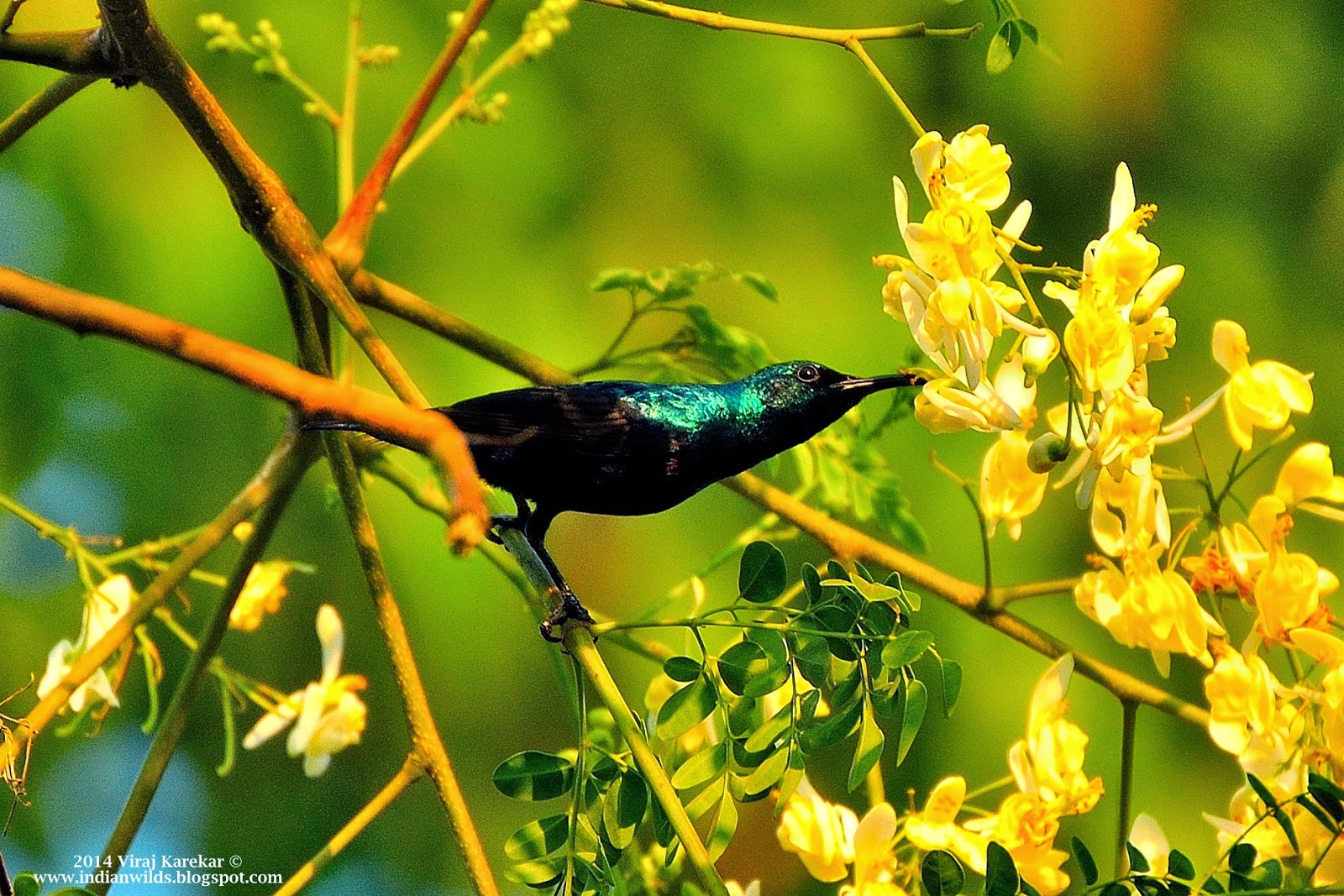 |
| The male purple sunbird has two distinct types of plumage. The breeding male is characterized by the metallic bluish-black body, and the tuft of crimson and yellow feathers under each wing. |
 |
| Less than 10 cm long they have a down-curve bill with brush-tipped tubular tongues that aid in nectar feeding. The male is glossy metallic purplish black on the upper parts with the wings appearing dark brown. The breeding male has the underparts also of the same purplish black, but non-breeding males may show a central streak of black on yellow underparts. |
 |
| They have Green Metallic head. And are seen in pairs or small groups and aggregations may be found in gardens with suitable flowers. They feed mainly on nectar but also take fruits and insects. Groups of as many as 40 to 50 individuals have sometimes been noted. |
 |
| Females are olive brown above with yellowish underside. There is a pale supercilium beyond the eye. There is a darkish eye stripe. The throat and breast are yellow becoming pale towards the vent. The outer tail feathers are tipped in white both in the male and female. |
 |
| In the breeding plumage, the male can be confused with the syntopic Loten's Sunbird which has a long bill and distinctive broad maroon band on the breast. Breeding males will sometimes show their yellow pectoral tufts in displays. |
 |
| There is a patch of bright blue on the shoulder of breeding males. The maroon shine on the feathers of the collar around the neck is visible mainly during the breeding seasons. |
 |
| The eclipse (non-breeding) male has a pale olive brown or yellow-grey upper plumage, except for blackish wings and tail. The chest and abdomen are yellow with a blue central streak extending from the throat to the abdomen. Males in the eclipse plumage were formerly separated as species currucaria. |
 |
| The non-breeding male purple sunbird has a much duller ‘eclipse’ plumage that resembles the female, with yellow underparts and a dark line of feathers running down the center of the throat and breast. |
 |
| A closer look at the eclipse (non-breeding) male |
 |
| Female Sunbirds are yellow-grey to olive brown above and yellowish below. The throat and chest are yellow turning paler towards the vent. She has a faint yellow supercilium (line above eye). Her black tail has a narrow white tip. |
 |
| Purple Sunbirds usually breed before the onset of the Monsoon (rainy) season, which varies by region. In northern India, it is from April to June and in Sri Lanka from January to June. The male performs a courtship display, which involves raising his head, fanning his tail and fluttering with partly open wings to expose his pectoral tufts ("arm pits") while singing to the female. |
 |
| The nest is constructed almost entirely by the female within a 5 - 10 day period. The pouch-shaped nest is made out of unwoven, thin strips of vegetation, lichens and bark, and held together with cobwebs. The entrance is on the side, often with an overhanging projection. The nest is typically suspended from a low branch, but at times are attached to man-made objects, such as wires. The inner cavity is expanded by the bird opening its wings and turning around inside. |
 |
| Conservation: Various conservation measures which benefit the purple sunbird are in place in the Kangchenjunga Conservation Area, in the Himalayas. WWF has partnered with the local and indigenous communities to conserve biodiversity. The area is protected and corridors have been established allowing migration of species to other protected areas. The purple sunbird is similarly protected within the Mahananda Wildlife Sanctuary, also in the Himalayas |


